Combined vs Third-Party Personal | Wheelchair Budgets What's the difference?
Combined vs Third-Party Personal | Wheelchair Budgets What's the difference?
Once a Personal Wheelchair Budget (PWB) has been agreed, one of the most important decisions is how that budget is used. Two common pathways are:
-
Combined (top-up) Personal Wheelchair Budget
-
Third-party Personal Wheelchair Budget
Both are clinically guided and must meet assessed needs. But they differ significantly in ownership, responsibility, cost structure, and flexibility. Understanding these differences early can help avoid confusion later in the process.
At a glance — Combined vs Third-Party PWB
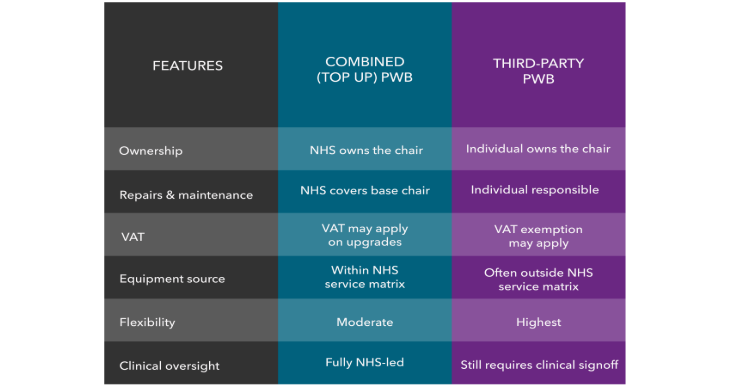

This table is the most important takeaway: the difference is not just choice, it is responsibility.
What is a Combined (Top-Up) Personal Wheelchair Budget?
A combined Personal Wheelchair Budget (sometimes called a top-up) allows you to build on NHS provision. The NHS prescribes a clinically appropriate wheelchair. You then have the option to enhance it.
There are typically two ways this happens:
1. Upgrading elements within the prescribed chair
This may include:
-
Additional seating components
-
Enhanced positioning features
-
Personalisation options (such as colour or accessories)
These features are not deemed clinically essential but may improve usability or comfort.
2. Moving within the NHS Matrix
In some cases, you may choose to move to a higher specification wheelchair within the NHS service’s approved range. This means remaining within the same clinical category (manual or powered), or selecting a more advanced model within the service’s matrix
Key considerations for Combined PWBs
-
The wheelchair remains NHS property
-
The NHS continues to manage repairs and maintenance for the base chair
-
You pay the difference between standard provision and upgrades
-
VAT is usually payable on non-essential upgrades
This pathway offers more choice, while retaining the reassurance of NHS support.
What is a Third-Party Personal Wheelchair Budget?
A third-party Personal Wheelchair Budget allows you to use your allocated funding with an independent supplier. This often means accessing equipment outside the NHS service’s standard matrix.
Why do people choose a Third-Party PWB?
This route is often used when additional funding is available, for example:
-
Personal funds
-
Charity support
-
Access to Work funding
-
Other funding routes
Rather than listing every possible source, it is more accurate to say that many funding pathways can be combined with a PWB, depending on individual circumstances. Contact our expert team for advice on your funding options.
Key characteristics of Third-Party PWBs
-
The wheelchair becomes your property
-
You are responsible for repairs, servicing, and maintenance
-
The NHS provides a contribution through the PWB
-
VAT exemption may apply, depending on eligibility
-
Equipment must still meet clinical requirements
This pathway offers the greatest level of flexibility but also introduces more responsibility.
The most important difference is ownership and responsibility
The biggest distinction between the two pathways is who owns the wheelchair.
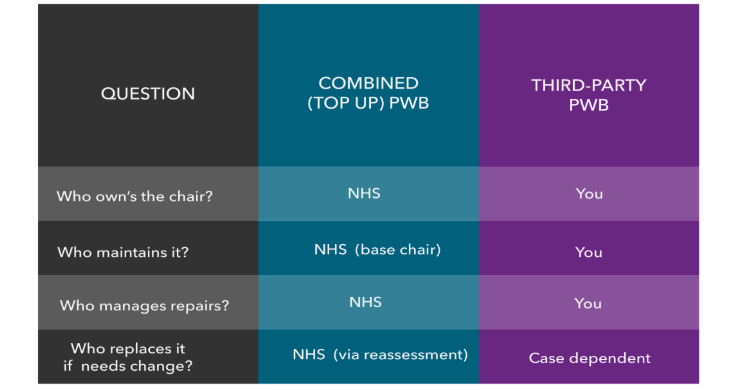
Ownership affects:
-
Long-term servicing
-
Risk and responsibility
-
What happens when clinical needs change
This is why pathway choice should always be guided by clinical context, not just preference.
VAT - A key but often overlooked difference
VAT is another important distinction.
-
Combined PWB: VAT is typically payable on upgrades or additional features
-
Third-party PWB: VAT exemption may apply where eligibility criteria are met
This can significantly affect the overall cost of the equipment.
However, VAT should never be the primary driver of decision-making. Clinical suitability and long-term outcomes remain the priority.
Which pathway is right?
There is no universal answer.
The appropriate pathway depends on:
-
Clinical complexity
-
Stability or progression of condition
-
Funding availability
-
Long-term support requirements
Combined PWB may be more appropriate when:
-
Ongoing NHS support is important
-
Clinical needs are likely to change
-
Continuity of service is a priority
Third-Party PWB may be considered when:
-
Additional funding is available
-
Specific equipment is required outside the NHS matrix
-
The individual is able to manage ongoing responsibilities
Why clinical guidance matters
Both pathways require clinical sign-off. However, the level of long-term responsibility differs significantly.
This is particularly important where conditions are progressive, postural needs are complex, and frequent reassessment may be required. In these situations, decisions should be made carefully and case by case.
Key questions to ask before choosing a Personal Wheelchair Budget option
Before deciding on a pathway, it is worth asking:
-
Who will maintain and repair the wheelchair?
-
What happens if clinical needs change?
-
Am I comfortable taking on long-term responsibility?
-
Does this option support future needs, not just current ones?
Clear answers to these questions help reduce uncertainty and support better outcomes.
Need help understanding your Personal Wheelchair Budget options?
There are multiple ways a Personal Wheelchair Budget can be used, and the right approach is not always immediately clear.
If you are unsure:
-
How combined and third-party options apply to your situation
-
What funding routes may be available
-
What responsibilities come with each pathway
It is reasonable to seek clear, clinically informed guidance before making a decision.
Personal Wheelchair Budget FAQs
What is the difference between combined and third-party PWB?
A combined PWB keeps the wheelchair within NHS provision, with optional upgrades. A third-party PWB allows you to use NHS funding toward equipment from an independent supplier, with full ownership and responsibility.
Do I own the wheelchair with a combined PWB?
No. The wheelchair remains NHS property, even if you contribute towards upgrades.
Do I have to pay VAT on a Personal Wheelchair Budget?
VAT may apply to upgrades in a combined PWB. In third-party arrangements, VAT exemption may be available depending on eligibility.
Can I use charity funding with a Personal Wheelchair Budget?
In some cases, yes. Personal Wheelchair Budgets can be combined with additional funding sources, depending on individual circumstances and local service arrangements.
Is third-party PWB better than combined?
Not necessarily. Each pathway has different responsibilities and risks. The most appropriate option depends on clinical needs, funding, and long-term support requirements.


