What Is a Personal Wheelchair Budget and How Does It Actually Work?
What Is a Personal Wheelchair Budget and How Does It Actually Work?
If you have been assessed by your local wheelchair service, you may have heard the term Personal Wheelchair Budget (PWB). But what does it actually mean in practice?
-
What does a Personal Wheelchair Budget cover?
-
How much might a Personal Wheelchair Budget be worth?
-
And how does it differ from an NHS wheelchair voucher?
This article explains how Personal Wheelchair Budgets work, who may be eligible, and what you should consider before making a decision.
What is a Personal Wheelchair Budget?
A Personal Wheelchair Budget is part of the NHS personalised care framework introduced in 2019. It is not a cash payment.
Instead, it is a defined amount of NHS funding allocated following a clinical assessment to meet your identified wheelchair needs. The budget reflects what the NHS would normally spend to provide clinically appropriate equipment based on their provision criteria set by the Integrated Care Boards. The purpose is to provide greater transparency around funding while maintaining clinical safety and suitability.
Who is eligible for a Personal Wheelchair Budget?
Eligibility for an NHS Personal Wheelchair Budget is determined by your local wheelchair service. In general, you may be eligible if:
-
You are registered with an NHS Wheelchair Service
-
You have undergone a clinical assessment
-
Your needs have changed
-
Your current wheelchair is no longer clinically appropriate
-
Your existing equipment is no longer economically viable to repair
It is important to understand that eligibility is not time-based. You are not automatically entitled to a new chair after a fixed number of years, and eligibility is based on clinical need and the economic viability of the equipment.
How much is a Personal Wheelchair Budget?
One of the most frequently searched questions is: “How much is a personal wheelchair budget?” The answer is: it varies.
The personal wheelchair budget amount depends on:
-
Your assessed clinical requirements
-
The type of wheelchair needed (manual, powered, specialist seating)
-
Local NHS commissioning arrangements
For some individuals, the budget may cover the full cost of NHS-provided equipment. In other cases, it may act as a contribution towards an alternative model or additional features, with the individual covering the difference. Your local wheelchair service will confirm the exact allocation following assessment.
Is a Personal Wheelchair Budget the Same as an NHS Wheelchair Voucher?
Many people still search for ‘NHS wheelchair voucher’ or ‘how much is an NHS wheelchair voucher worth’. The voucher scheme was the predecessor to the Personal Wheelchair Budget framework.
In simple terms:
-
The voucher scheme provided a set monetary value towards a wheelchair.
-
The Personal Wheelchair Budget model provides a more structured and transparent funding approach linked directly to clinical assessment.
Today, the PWB system allows wheelchair services to offer different pathways depending on individual needs.
The Three Types of Personal Wheelchair Budget
A Personal Wheelchair Budget can typically be delivered in three different ways.
1. Notional Budget (Standard NHS Provision)
With a notional budget, the NHS prescribes and supplies the wheelchair directly. The wheelchair remains NHS property, and repairs and maintenance are fully managed by the wheelchair service. This pathway offers the least flexibility, but it provides full service support and no cost to the user.
2. Notional Budget with Contribution (combined or upgrade)
In this pathway, the NHS provides the clinically prescribed wheelchair, but the individual may choose to add features or upgrades.
These might include:
-
Upgraded components
-
Additional accessories
-
Personalisation features such as colour options
The wheelchair remains NHS property, but the individual pays the difference between the standard NHS provision and the upgraded features.
Repairs for the base chair remain covered by the NHS, while additional features may only be covered under warranty. Importantly, any upgrade must remain within the same clinical category, such as manual or powered.
3. Third-Party Personal Wheelchair Budget
With a third-party PWB, the NHS provides the allocated budget amount towards a wheelchair from an independent supplier. The individual owns the wheelchair and is responsible for repairs and maintenance, although the PWB usually includes a contribution toward servicing costs.
This option provides the greatest flexibility and choice, but the equipment must still meet the clinical needs identified during assessment.
Key differences between the three pathways
The main differences between the three PWB options include: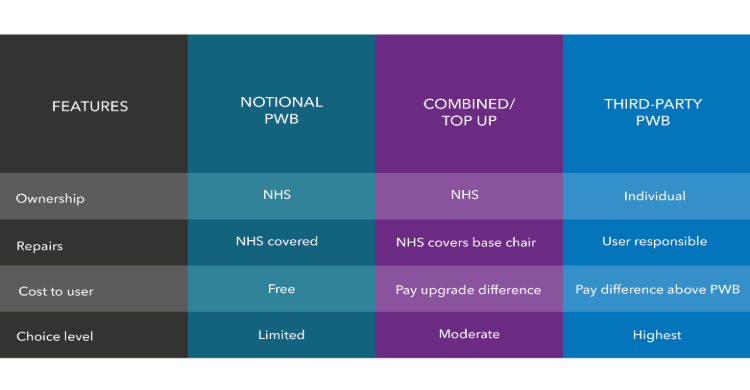
All options must still meet the clinical prescription determined during assessment.
How to Get a Personal Wheelchair Budget
Another common question is: “How to get a personal wheelchair budget?”
The process generally includes:
-
Referral to your local NHS Wheelchair Service
-
Clinical assessment by a clinician within the wheelchair service
-
Identification of appropriate equipment
-
Confirmation of eligibility and allocated budget
-
Discussion of available pathways
A Personal Wheelchair Budget cannot usually be requested independently of a clinical assessment. It forms part of the NHS wheelchair provision process.
What happens if the equipment costs more than the budget?
If the equipment chosen costs more than the allocated budget, you may be able to pay the difference, depending on local service arrangements. Before making that decision, it is important to understand:
-
Who will maintain and repair the equipment
-
What happens if your clinical needs change
-
Warranty coverage
-
Long-term servicing arrangements
Funding contributions should never compromise clinical appropriateness or long-term safety.
When might a third-party option require careful consideration?
While third-party arrangements can offer flexibility, they may not be appropriate in all circumstances. For example:
-
Rapidly progressing neurological conditions
-
Complex postural needs requiring frequent review
-
Situations where long-term service responsibility must remain clearly defined
In some cases, remaining within NHS provision or using a combined approach may provide greater continuity of care. These decisions are always made case by case, with clinical guidance.
Key questions to ask before choosing a pathway
Before deciding which pathway may be appropriate, it can help to ask:
-
Is this clinically appropriate for my current and future needs?
-
Who is responsible for maintenance and repairs?
-
What happens if my condition changes?
-
Is my family fully informed about the funding structure?
Cost is often the first question people ask, but the most important factor is ensuring the wheelchair meets long-term clinical needs.
A Personal Wheelchair Budget is not a retail purchase
A Personal Wheelchair Budget is not simply about buying equipment. It is a clinically guided NHS funding pathway designed to support appropriate wheelchair provision. f you are unsure about:
-
Your eligibility
-
How much your budget may be
-
Whether combined or third-party pathways are appropriate
-
What responsibilities come with each option
Seeking clear, clinically informed guidance can help you make a confident decision. Clarity supports better outcomes, for both service users and clinicians. Get in touch with our friendly expert team by email or call.
Personal Wheelchair Budget FAQs
What is the difference between combined and third-party PWB?
A combined PWB keeps the wheelchair within NHS provision, with optional upgrades. A third-party PWB allows you to use NHS funding toward equipment from an independent supplier, with full ownership and responsibility.
Do I own the wheelchair with a combined PWB?
No. The wheelchair remains NHS property, even if you contribute towards upgrades.
Do I have to pay VAT on a Personal Wheelchair Budget?
VAT may apply to upgrades in a combined PWB. In third-party arrangements, VAT exemption may be available depending on eligibility.
Can I use charity funding with a Personal Wheelchair Budget?
In some cases, yes. Personal Wheelchair Budgets can be combined with additional funding sources, depending on individual circumstances and local service arrangements.
Is third-party PWB better than combined?
Not necessarily. Each pathway has different responsibilities and risks. The most appropriate option depends on clinical needs, funding, and long-term support requirements.


